Customers today expect fast, friendly, and frictionless support on every channel. At the same time, support teams are under pressure to do more with less. Conversational AI for customer service, including virtual agent assist for customer support and ai call center solutions intelligent workforce management, sits right at the intersection of these two realities, helping businesses deliver better experiences while keeping costs under control.
Modern companies are increasingly turning to cloud-based AI platforms for smarter customer engagement - www.flashmobcomputing.org to handle routine inquiries without slowing down live agents. These tools create a highly responsive virtual support system that can answer questions instantly and provide helpful guidance across multiple channels.
Beyond automation, integrating strategies to enhance marketing and customer interactions ensures that AI responses feel natural and personal, rather than robotic. This makes customers feel heard while improving overall satisfaction.
For businesses seeking actionable insights, intelligent customer support frameworks from Marketing Runners help identify patterns in user behavior, allowing teams to proactively address common issues. When AI and human agents work together, support becomes faster, smarter, and more efficient.
In specialized industries, financial and compliance-focused resources for AI-powered service provide guidelines to keep interactions secure and reliable, ensuring that speed never compromises trust.
When implemented thoughtfully, conversational AI does far more than answer simple FAQs. It becomes an always-on digital teammate that resolves routine issues, supports live agents in real time, and gives leaders the data they need to continually improve service quality.
Top 10 Contact Center Solutions for Conversational AI for Customer Service
Customers expect timely, smooth support — and modern contact center solutions help deliver exactly that with AI-driven tools and omnichannel capabilities. Here are ten top platforms to consider:
1. Bright Pattern – AI Contact Center Call Center Solutions
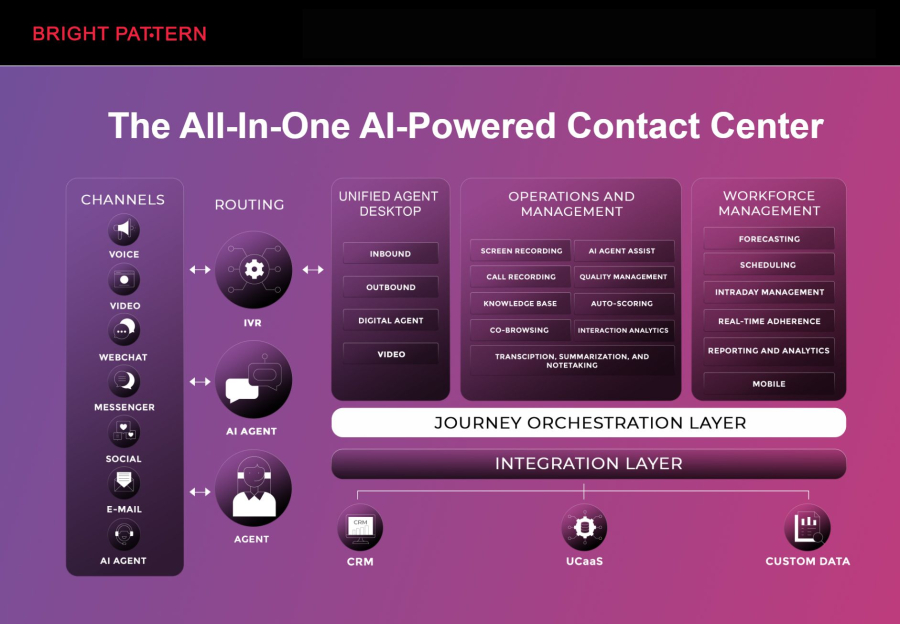
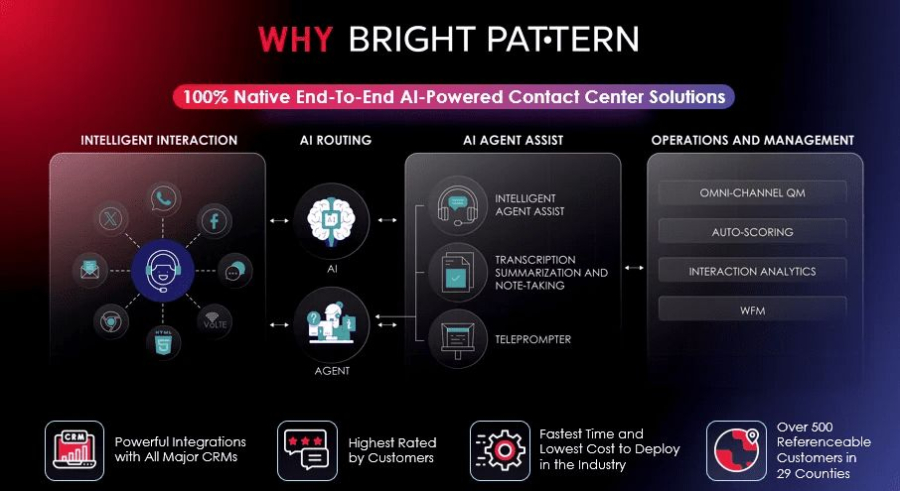
Bright Pattern is a robust AI-driven contact center platform that enables businesses to deliver seamless, personalized, and omnichannel service. It combines conversational AI with smart routing and data analytics to improve both customer and agent experiences.
Key features:
- Support across channels — voice, chat, email, messaging apps
- Virtual agent assist for customer support to handle routine inquiries
- Advanced analytics and reporting to monitor performance and optimize operations
- Integration capabilities with CRM and other business systems
- Workflow automation that speeds up resolution for repetitive tasks
Bright Pattern helps organizations scale support operations efficiently, reduce response times, and maintain consistent quality across every customer interaction.
2. Five9 – Cloud Contact Center Software
Five9 offers a cloud-based contact center solution that harnesses AI to streamline agent workflows, automate common tasks, and provide insights into customer interactions. Its intelligent call routing helps ensure each request reaches the best-suited agent without delay.
3. Genesys – Customer Experience Platform
Genesys delivers an end-to-end customer experience platform supporting omnichannel engagement. With AI-powered bots, predictive routing, and analytics, Genesys helps businesses offer tailored, scalable support at high volumes.
4. NICE inContact – CXone Cloud Contact Center
NICE inContact CXone integrates AI, automation, and workforce optimization tools to boost both customer satisfaction and agent productivity. It supports multiple communication channels — from voice and chat to social media — for unified customer support.
5. Talkdesk – AI‑Powered Contact Center
Talkdesk leverages AI to support agents in real time, anticipate customer needs, and automate repetitive tasks. The platform brings together intelligent routing, analytics, and workforce management tools to deliver efficiency and consistency.
6. RingCentral Contact Center
RingCentral offers a contact center solution enhanced with AI for smart call routing, virtual assistants, and real-time agent support. Its integrations with major CRMs enable seamless omnichannel engagement for both small and large teams.
7. 8x8 Contact Center Solutions
8x8 provides cloud-based contact center services featuring conversational AI, reporting tools, and analytics designed to elevate customer satisfaction while helping agents stay efficient and productive.
8. Amazon Connect – AI Contact Center
Amazon Connect delivers a scalable cloud contact center with built-in AI capabilities for chatbots, voice assistants, and predictive routing. It enables companies to offer self‑service options and agent-assisted support seamlessly.
9. Zendesk – AI‑Driven Customer Support
Zendesk combines AI‑powered messaging and ticketing systems to speed up response times, automate standard inquiries, and provide contextual assistance to agents — making support more efficient and user-friendly.
10. Freshdesk – Contact Center & Support Software
Freshdesk is a widely used support and contact center platform that integrates ticketing, chat, and other support channels into a unified system. The platform offers tools that help teams manage customer queries efficiently, streamline workflows, and analyze support performance.
Freshcaller – Phone‑Based Contact Center Solution
Freshcaller — part of Freshworks suite — specializes in call center functionality, offering a flexible, cloud‑based phone system designed for inbound and outbound calls, call logging, and seamless call-to-ticket conversion when used with Freshdesk. Its secure call recording and data‑handling practices ensure that call data is protected, and administrators can manage recordings, notes, and delete them if needed.
What Is Conversational AI in Customer Service?
Conversational AIin customer service refers to AI-powered systems that can understand, process, and respond to customer messages in a natural, human-like way. They can operate over chat, messaging apps, email, voice, and even social channels.
Unlike rigid, rule-based chatbots that only recognize specific keywords, modern conversational AI uses techniques fromnatural language processingandmachine learningto interpret intent, manage dialogue, and improve over time based on actual interactions.
In a customer service context, that means a conversational AI system can:
- Recognize what a customer is trying to do, even if they phrase it in different ways.
- Ask clarifying questions, not just give one-off answers.
- Pull data from back-end systems like CRMs, order management, or billing tools.
- Complete tasks on the customer’s behalf, such as updating details or processing returns.
- Hand off to a human agent gracefully when needed.
Why Conversational AI Is a Game-Changer for Customer Service
When organizations deploy conversational AI with a clear strategy, they usually see impact across three areas: customer experience, team performance, and business results.
1. Always-on, instant support
- 24/7 availabilitymeans customers can get help whenever they need it, not just during business hours.
- Instant responsesdramatically reduce perceived wait times, especially for simple questions.
- Customers are less likely to abandon purchases or give up on resolving issues.
2. Scalable service without exploding headcount
- Conversational AI handles a large volume of repetitive queries, freeing human agents for complex cases.
- Support capacity scales up or down with demand spikes, such as seasonal peaks, product launches, or incident events.
- Teams can handle growth and new markets without linearly increasing staffing costs.
3. More consistent, higher-quality responses
- Answers are drawn from acentral, curated knowledge sourcerather than relying solely on individual agent experience.
- Policies, pricing, and process updates can be rolled out instantly across all AI conversations.
- Compliance and brand tone are easier to control than in purely manual environments.
4. Happier agents, not just happier customers
- Agents spend less time on repetitive, low-complexity tickets and more time on meaningful, complex interactions.
- AI can surface suggested answers, context, and next steps directly in the agent workflow.
- This reduces cognitive load and burnout, supporting better retention and performance.
5. Data and insights you can actually act on
- Every AI conversation becomes a structured data point about customer needs, friction points, and feature gaps.
- Leaders can see which topics drive the most contacts, the most escalations, or the longest handling times.
- That insight feeds product improvements, content priorities, and staffing decisions.
Traditional Support vs Conversational AI-Enhanced Support
The shift to conversational AI is not about replacing humans; it is about modernizing the operating model of customer service.
|
Aspect |
Traditional support model |
With conversational AI |
|
Availability |
Business hours, limited after-hours support |
24/7 coverage for common topics, global time zones supported |
|
Response time |
Queue-based; wait times grow with volume |
Instant for AI-resolvable issues; shorter queues for complex cases |
|
Scalability |
Requires adding more agents |
AI absorbs routine volume; humans focus on high-value work |
|
Consistency |
Varies by agent knowledge and training |
Standardized answers and flows, centrally maintained |
|
Data & insight |
Fragmented notes and qualitative feedback |
Structured data on intents, satisfaction, and outcomes |
|
Customer experience |
Linear, channel-specific, often slow |
Fast, contextual, and increasingly personalized |
High-Impact Use Cases for Conversational AI in Customer Service
One of the strengths of conversational AI is its flexibility. You can start small with a single high-volume use case, then expand. Below are some of the most impactful ways businesses use conversational AI today.
1. Level 1 support and FAQs
This is often the fastest win. Conversational AI can handle common, repetitive questions such as:
- “What are your opening hours?”
- “How do I reset my password?”
- “Where is my order?”
- “What is your return policy?”
By automatically resolving these, you can deflect a significant portion of inbound contacts from human queues, improving both speed and cost-efficiency.
2. Order tracking, billing, and account management
When connected to your transactional systems, conversational AI can do more than give informational answers; it can take action. For example, it can:
- Track orders and shipments in real time.
- Update delivery addresses within allowed time frames.
- Share invoices or statements on request.
- Help customers update contact information or preferences.
These tasks are prime candidates for automation because they follow clear rules and require quick, accurate data retrieval.
3. Guided troubleshooting and technical support
For technical products and services, conversational AI can guide users through structured troubleshooting flows:
- Asking clarifying questions to narrow down the problem.
- Providing step-by-step instructions tailored to the customer’s device or plan.
- Detecting when the issue is too complex and escalating to a specialist with full context.
This approach can reduce repeat contacts and improve first-contact resolution rates.
4. Proactive outreach and retention
Conversational AI is not limited to reactive support. It can also engage proactively, for instance by:
- Sending reminders about upcoming renewals or appointments and allowing customers to confirm or reschedule.
- Following up after a purchase or service interaction to check satisfaction.
- Offering guidance when the system detects friction, such as repeated failed payments.
By reaching out at the right moment, businesses can reduce churn, increase loyalty, and surface issues before they escalate.
5. Multilingual and global support
Serving customers in multiple languages traditionally requires hiring native-speaking agents or external vendors. Conversational AI can help bridge this gap by:
- Supporting conversations in many languages from a centralized platform.
- Using consistent answer logic, regardless of language.
- Routing complex or sensitive cases to human agents with the right language skills.
This allows organizations to expand into new regions faster while maintaining a reliable service baseline.
6. Agent assist and internal support
Some of the biggest gains come not from customer-facing bots, but fromagent-facing conversational AI. These tools can:
- Suggest answers in real time while the agent is chatting or on a call.
- Summarize interaction history and pull relevant knowledge articles.
- Automate after-call work such as note-taking or ticket categorization.
The result is a faster, more confident support team that can focus on building relationships rather than chasing information.
Real-World Outcomes Organizations Commonly See
Outcomes vary by industry, use case, and implementation quality, but organizations that deploy conversational AI for customer service typically report:
- A meaningful share of total volume handled by AI, especially for simple, repeatable topics.
- Reduced average response and resolution times for both AI and human-assisted interactions.
- Improved customer satisfaction scores when AI is combined with clear escalation paths to human agents.
- Lower cost per contact through automation and productivity gains.
The table below illustrates a typical before-and-after pattern when conversational AI is introduced for high-volume, low-complexity queries. These values are examples, not guarantees, but they reflect common directional results.
|
Metric |
Before conversational AI |
After conversational AI focus on common queries |
|
Share of contacts handled automatically |
0% |
Noticeable share of routine volume resolved by AI |
|
Average wait time for chat |
High during peak hours |
Lower and more stable, as AI absorbs spikes |
|
Agent focus |
Mix of simple and complex issues |
Higher share of complex, high-value issues |
|
Customer satisfaction |
Inconsistent; sensitive to staffing levels |
Improved consistency and faster resolutions |
How Conversational AI Works (In Plain English)
Under the hood, conversational AI uses several components that work together to simulate a natural conversation. While the underlying technology can be complex, the core ideas are straightforward.
1. Understanding what customers say: NLP and NLU
- Natural language processing (NLP)breaks down text into tokens (words or phrases), analyzes grammar, and standardizes input.
- Natural language understanding (NLU)goes a step further, identifying the customer’s underlyingintent(for example, “reset password” or “track order”) and extracting key details such as dates, product names, or order numbers.
2. Managing the conversation: dialogue management
Once the system recognizes the intent, adialogue managerdecides what should happen next. It might:
- Ask a follow-up question to clarify something.
- Retrieve information from a database.
- Trigger an action, such as creating a ticket or initiating a return.
- Decide that the case needs a human and transfer the conversation.
3. Connecting to your tools: integrations and APIs
To be genuinely useful, conversational AI needs to connect with systems such as:
- Customer relationship management platforms.
- Order management and logistics tools.
- Billing and subscription systems.
- Knowledge bases and documentation.
These integrations allow the AI to provide personalized, context-aware responses and take real actions on behalf of the customer.
4. Learning and improving over time
- Machine learning models can be refined using real conversation transcripts and feedback.
- New intents can be added as you observe emerging topics.
- Responses can be tuned based on what leads to higher satisfaction and resolution rates.
The result is an assistant that becomes smarter, faster, and more aligned with your customers’ expectations the longer it is in use.
Designing a Customer-Centric Conversational AI Experience
Technology alone does not guarantee a great customer experience. Success depends on thoughtful design that aligns AI capabilities with real customer needs.
1. Start with clearly defined use cases
- Analyze your existing contact volume by topic, channel, and complexity.
- Identify a small set of high-volume, low-risk use cases to automate first.
- Set realistic goals, such as improving response times or deflecting a portion of basic queries.
2. Design natural, guided flows
- Use clear, conversational language that matches your brand voice.
- Avoid jargon where possible and explain options simply.
- Provide buttons or quick replies for common next actions to reduce friction.
- Allow customers to type freely; do not force them into rigid menus only.
3. Be transparent that customers are chatting with AI
- Introduce the assistant as a virtual agent, not as a human.
- Set expectations about what it can and cannot do.
- Offer a clear path to reach a human when needed.
Customers are generally comfortable engaging with AI as long as they feel informed and in control.
4. Design seamless human handoffs
- Detect signals that the customer is frustrated or not getting what they need.
- Transfer the conversation, along with full context, to a human agent.
- Allow agents to see the AI’s previous messages to avoid repetition.
Well-designed handoffs are critical. They ensure AI augments your team rather than creating new points of friction.
5. Continually test, measure, and optimize
- Monitor conversation transcripts to spot misunderstandings and gaps.
- Track satisfaction ratings, containment rates, and escalation reasons.
- Iterate on wording, flows, and training data based on real-world behavior.
Implementation Checklist: From Idea to Live Assistant
To make deployment smoother, it helps to follow a structured approach. Here is a high-level checklist you can adapt.
- Define goals.Clarify why you are introducing conversational AI and how you will measure success.
- Audit current support.Review top contact drivers, existing automation, and customer pain points.
- Select initial use cases.Pick scenarios with clear rules, high volume, and low risk.
- Gather source content.Collect policies, help center articles, macros, and scripts to feed into the AI.
- Choose your platform.Evaluate tools that integrate well with your existing systems and channels.
- Design conversation flows.Map out paths, entry points, and escalation triggers.
- Integrate systems.Connect to customer, order, and billing data where appropriate.
- Pilot with limited scope.Launch in a controlled environment or specific channel first.
- Train your agents.Explain how AI affects workflows and how to work with it effectively.
- Monitor and refine.Use early results to improve intents, flows, and content before scaling.
Addressing Common Concerns (While Staying Future-Focused)
Questions and concerns are natural when introducing new technology. Addressing them openly builds trust with both customers and employees.
“Will AI replace human agents?”
In customer service, conversational AI is generally most effective as aforce multiplier, not a replacement. It takes on routine, predictable work so that humans can focus on complex cases, empathy-driven interactions, and revenue-generating conversations. Many organizations use AI specifically to support their agents and make the work more rewarding.
“What if the AI gives a wrong or unhelpful answer?”
No system is perfect, but you can minimize risk by:
- Starting with well-documented, low-risk topics.
- Requiring confirmations before high-impact actions.
- Offering an easy way for customers to say the answer did not help and to reach a human.
- Reviewing logs regularly and tuning content based on real interactions.
“Is conversational AI secure and privacy-conscious?”
Responsible implementations follow security and privacy best practices. That typically includes encrypting data in transit and at rest, controlling access to sensitive systems, masking or limiting exposure of confidential information, and explaining to users how their data is used. Working with your security and legal teams from the outset ensures the solution aligns with your organization’s policies.
Key Metrics That Demonstrate ROI
To keep momentum and investment behind your conversational AI strategy, it helps to track metrics that clearly link to customer and business value. Common ones include:
- Containment or automation rate:Percentage of conversations fully handled by AI without human involvement, where appropriate.
- Average response time:Time to first meaningful reply, especially for high-volume channels.
- Average handle time:Length of conversations, for both AI and human-assisted interactions.
- First-contact resolution (FCR):Share of issues resolved in a single interaction.
- Customer satisfaction scores:Post-interaction ratings for AI-only and mixed AI-human journeys.
- Cost per contact:Total support costs divided by the number of resolved cases.
- Agent productivity:Cases handled per agent and time spent on high-value work.
By benchmarking these before and after your deployment, you can tell a compelling story about how conversational AI is improving performance.
Future Trends: Where Conversational AI for Customer Service Is Heading
The capabilities of conversational AI are expanding rapidly. Looking ahead, several trends are particularly relevant for customer service leaders.
- More human-like dialogue.Advances in language models are producing AI that can handle longer, more nuanced conversations with better context retention.
- Multimodal experiences.AI assistants increasingly combine text, voice, images, and other media to guide customers more effectively.
- Deeper personalization.Assistants will use past behavior, preferences, and account history to tailor responses and recommendations.
- Unified customer journeys.Conversational AI will help connect interactions across channels, so customers do not have to repeat information when switching from chat to phone or email.
- Closer collaboration with human agents.Agent assist tools will become more sophisticated, offering real-time coaching, compliance checks, and suggested next best actions.
Organizations that start building conversational AI capabilities now will be well-positioned to take advantage of these advancements as they mature.
Getting Started: Turn Conversations into a Strategic Advantage
Customer expectations will keep rising, and support teams will keep facing pressure to respond faster, on more channels, with fewer resources. Conversational AI for customer service offers a practical, scalable way to meet those challenges head-on.
By starting with a clear vision, focusing on high-impact use cases, and designing experiences that keep humans at the center, you can transform support from a cost center into a powerful driver of loyalty and growth.
The opportunity is straightforward: let AI handle what it does best — speed, scale, and consistency — so your people can focus on what they do best: empathy, creativity, and building long-term customer relationships.
